








Family business owners desire a successful business and healthy family relationships. However, developing effective family functioning is easier said than done.
In family-owned companies, how the family interacted in the past can affect the way the business is run today.“The legacy of previous generations has a huge impact on today’s opportunities and challenges in a family business,” says Matt Starr, president of Boston Showcase Company, a foodservice and restaurant kitchen design, equipment and supplies dealer that has been family-owned since 1913. “There is always tension between family and business; the next generation has to balance keeping what works and improving what doesn’t. Stronger relationships and better communication are the keys to making ‘family’ a positive force in the business and not a challenge to overcome.”
Mental health professionals describe the problem by considering the family as an emotional unit. “Families so profoundly affect their members’ thoughts, feelings and actions that it often seems as if people are living under the same ‘emotional skin,’” notes the Bowen Center for the Study of the Family. “People solicit each other’s attention, approval and support, and they react to each other’s needs, expectations and upsets. This connectedness and reactivity make the functioning of family members interdependent. A change in one person’s functioning is predictably followed by reciprocal changes in the functioning of others.”
Family members can influence each other through negative or positive emotions, but research has shown that family dysfunction is surprisingly common. In a survey of 354 undergraduate and graduate students from four northeastern universities by Richard P. Conti of Kean University, more than 40% of the participants said they had been estranged from a family member (Journal of Psychology and Behavioral Science, 3[2]:28-35, 2015). Emotional cut-off is especially problematic in families who own a business together because the lack of communication can lead to lost opportunities for problem solving and value creation.
Despite the challenges, developing strong family functioning is critically important for business families because it often results in the best-case scenario of deeply connected family relationships and ongoing business success. Bowen family systems theory (BFST), developed by psychiatrist Murray Bowen, offers important insights that can help families achieve this elusive goal.
A key element of Bowen’s theory is that the relationships between people, rather than any one person’s behavior, are the source of family dysfunction. The theory uses systems thinking to describe the interactions within the family unit. Importantly, according to Bowen, any one family member can improve the dynamic in the family through their behaviors.
“The typical business school rules don’t always apply in the family context,” Starr says. “We found that improving our family dynamic within and across generations was a prerequisite for working on our shared company goals.”
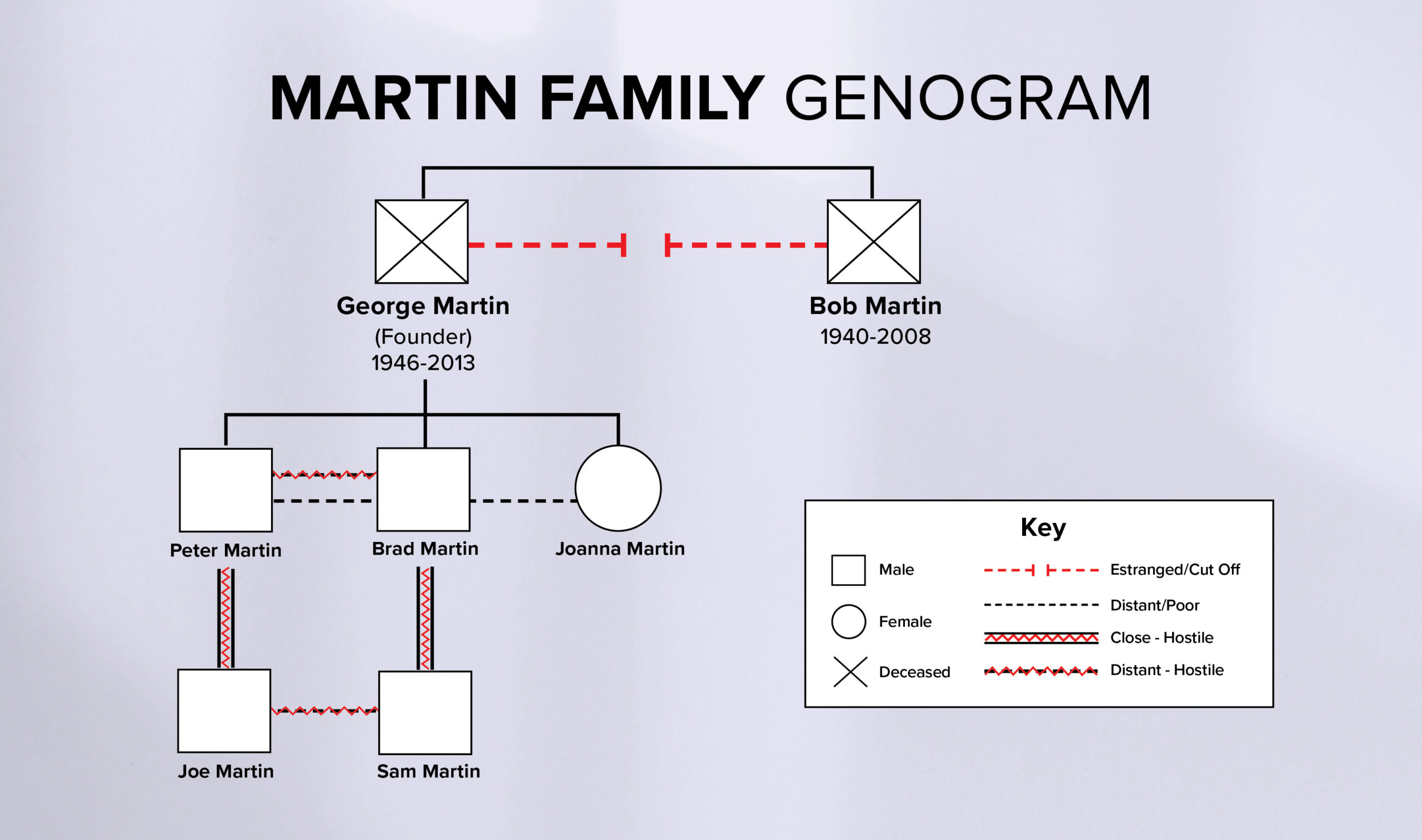
The story of the Martin family illustrates family members’ emotional interconnectedness, which can extend beyond one generation to affect the next .
The Martins: Two generations of conflict
George Martin founded MartinCorp, a manufacturer of building products. Seeing rapid company growth, George wanted someone he could trust to work with him, so he invited his older brother, Bob, to join the firm. Growing up, Bob had always been the leader among the two siblings. At the time, he had a successful law practice but was intrigued by the idea of working together as a family.
Unfortunately, things did not go as planned. Bob and George disagreed on nearly every decision. Their discussions could be better described as shouting matches followed by long periods of no communication. After a year, furious at George’s treatment of him after he gave up his law practice, Bob left the business. The brothers barely spoke for the remainder of their lives. When Bob passed away in 2008, George did not attend his funeral.
The company’s performance suffered for a couple of years after Bob’s departure but before long was back on track. As the company grew, George encouraged his children, Peter, Brad and Joanna, to join the business. Peter worked for a building material chain for a few years before joining the business, while Joanna joined immediately after college, and Brad, who found college was not for him, joined at age 20.
George vowed to make things better for the family than the situation with Bob. To do this, he decided that each of his children should be equal in the business. Rather than assigning roles, he let them find their own way and promised that if they worked in the business, they would have an equal share of the equity. But Joanna found working while taking care of her children impossible to manage and left the firm.
To George’s consternation, Peter and Brad’s relationship evolved to look a lot like his relationship with his brother. Peter and Brad had very different capabilities and work styles. They spoke only as required and often were hostile toward each other. George emphasized they should both stay in the business, so despite their pattern of heated arguments followed by periods of no communication, both brothers remained at MartinCorp.
When George passed away unexpectedly in 2013, Joanna was disappointed that she did not receive any equity in the business. After that, she rarely saw her brothers. Meanwhile, as no successor had been named for the business, Peter and Brad struggled to work together as co-CEOs but dreaded each day in the office. As 50/50 owners, they each encouraged their sons, Joe (Peter) and Sam (Brad), to join the firm.
Peter and Brad were each close to their sons but often found their conversations devolving into arguments. When Joe and Sam each joined the business in 2018, they found their previously comfortable, if somewhat distant, relationship as cousins quickly becoming frayed by constant turf battles and arguments. As a group, Peter, Brad, Joe and Sam found themselves struggling to make even the simplest decision without getting into a major argument. All of this infighting was impacting the business as well. With sales slumping, the family reluctantly decided to sell the business.
Following the sale, Peter, Brad and their respective families live entirely separate lives. They no longer have a family business but at least they have a veneer of peace. In private, though, each family member expresses deep regret for what happened — and is convinced the other branch of the family is totally at fault.
The Martins are a fictional family whose story is based on the experiences of several families I have worked with. If any portion of the story sounds familiar, that’s not surprising. Families often believe they are unique in the problems they face. Embarrassed by their perceived failings, they tend to keep their issues to themselves, but the truth is that elements of this story are common to many families.
Steps toward mending relationships
What could the Martin family have done differently to achieve the outcomes they wanted: close family relationships and a successful business? A common recommendation to manage these problems is to create a governance structure and succession plan. But those steps would not have resolved the problem unless the family relationships were first fixed. A few steps taken directly from Bowen Family Systems Theory could have made all the difference for the Martin family:
Identify the relationship patterns in your family history. A genogram (see figure) is a great way to visualize the events and family dynamics of the past. Families tend to pass relationship styles across generations, so seeing prior patterns can help families identify better paths forward. If the Martin family had acknowledged the estrangement between George and Bob and those in their children’s generation, and asked questions in an effort to better understand what happened, they might have discovered ways to improve relations in future generations.
Pay attention to your emotions. Life is hectic, and we often don’t take the time to consider how we are feeling. Feelings can act as your thermometer; they provide clues to your wellbeing and warning signs when there is a problem. This is important because problems that are not identified are virtually impossible to solve! Simply the act of considering how you are feeling during or after a challenging family conversation builds your capacity to have a more productive conversation the next time.
Try taking a deep breath before responding to a highly emotional conversation. This gives your brain time to think about how you want to respond versus saying something you might regret later. Thoughtful responses can make all the difference in how your family member responds back to you.
Identify your own beliefs and values and be willing to stand by them. It can be hard in families to speak when you disagree, but avoiding conflict by not expressing your feelings doesn’t solve any problems. Ask others about their ideas and feelings, and be willing to consider changing your own ideas in response to theirs. Identifying and acting on shared values can build a shared sense of purpose that makes it easier for family members to work through hard times.
Take responsibility for your own part in the family dynamic. Each branch of the Martin family blamed the other for their problems. but blaming someone else will not change or resolve anything. If any member of the family had begun to ask what they could do to make things better and taken responsibility for doing that, the situation would have improved.
Families pass emotions — positive or destructive – among each other. When each person reacts to the other, similar emotions build on each other. More anger leads to even more anger. If someone takes responsibility for bettering the situation by trying to understand the person they’re arguing with, things will slowly improve. When conversations become more open, opportunities for innovation and problem solving emerge.
Be curious and ask lots of questions. You might be surprised what your family members are thinking. Curious questions are not questions designed to lead a person to the answer you want. Instead, they are broad enough to allow the person to respond in an unexpected way. Family members must take responsibility for creating spaces where others can openly share their ideas and have them considered. If the Martin family had done this, they might have been able to identify solutions to their business challenges and relationship problems.
Healthier family, stronger business
Family systems theory is widely used by family therapists to improve family relationships, but it can also help family businesses perform better. Because of the strong emotions involved in family relationships, these steps, while simple, are harder to follow than you might think. To get started, pick one and try it. Don’t be surprised if your family doesn’t follow suit or fails to notice that you tried something new. That’s normal. It might take months, but eventually, if one person changes their behavior, others in the family will, too.
Don’t worry about what others are doing. Ask yourself if you are behaving in line with your values when you interact with your family. Are you curious about what your family members are thinking and feeling? Are you responding calmly, even if others are bringing negative emotions into the conversation? Are you opening the door for different ideas to be heard and incorporated? Could you do that a little bit better next time? This is the slow but sure path to achieving business success and family unity.