








You could say the Lange twins of Lodi, Calif., are intoxicated by the grape growing business. Randall and Brad Lange represent the fourth generation to farm their family’s land. About a decade ago they took the next step and built a winery. Now all five of the twins’ children work in the family business, LangeTwins Family Winery and Vineyards.
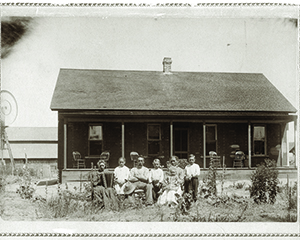 The Langes have been farming in Lodi since the 1870s. Johann and Maria Lange started out as watermelon farmers. The family moved into grape growing in 1916, under second-generation leader Albert Lange and his son, Harold. Fourth-generation twins Randall and Brad Lange, now 67, began farming on their own in 1974 and expanded into winemaking in 2006.
The oldest fifth-generation member, Randall’s daughter Marissa Lange, 39, is president of the winery. The family has set up governance structures to smooth the way for a partnership among the cousins and, potentially, the sixth generation.
“We certainly knew, growing up, that the family survived by the farm,” Marissa says. “The business got started a few years before I was born, and our parents invested every dime they had.”
LangeTwins grows grapes and also manages vineyards for clients. The company produces wine from its vineyards and provides custom winemaking and private-label bottling services.
Going against the grain
The twins’ father, Harold, was born in 1920, four years after the family started growing grapes. Harold had worked closely with his father, Albert. The family tradition continued when Harold’s sons—Randall and Brad and their older brother, Stanton—joined him on the farm.
But conflicts arose over ownership and authority. The twins decided to form their own venture, and Stanton established a separate business on a different part of the family property. Their father, Harold, wasn’t pleased with the transition; he retired soon after his sons bought and divided the rest of the farm.
“My dad retired because he was disappointed,” Randall says. “It was his vision and dream to work with his sons. When it didn’t work out, he withdrew.” Harold passed in 2002.
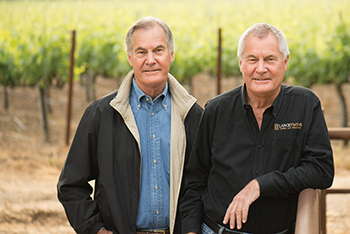 As twins, Randall and Brad were always close, and they were eager to go into business together. Brad, the administrative expert, handled logistics, finances and orders. Randall, the viticulture expert, worked in the field from early morning until late in the evening. Neither twin has ever had an official title, Randall says.
“I really can’t speak with authority because I’ve never been anything but a twin, but we spend so much time together,” Randall says. “We know how we react and how we respond. We build off each other’s energy.”
Brad says that at first, there wasn’t a clear separation between in-the-office and in-the-fields. When harvest time came, both men spent days and weeks at a time in the field.
The twins aren’t always completely in synch, Randall notes. “Brad and I have had disagreements, significant disagreements,” he says. “The strength we have, that a lot of other businesses don’t, is we know we’re better working together than apart. We have a means and procedure to address issues, and we address them and then we move on.”
“We’re not looking over each other’s shoulders,” Brad says. “We didn’t have time for that. Our main objective was to build a family heritage. We wanted to continue what our dad built with his good reputation and name.”
The high level of trust between the twins gave each man a high degree of autonomy in his area of responsibility. “One person took the lead—small decisions were made individually,” Randall says. For example, he says, Brad secured the loans and negotiated the contracts, and he signed the documents without question.
Family fortification
Randall depended on his wife, Charlene, and Brad on his wife, Susan, to keep the family afloat practically and financially while the brothers made a go of their own vineyard. Both wives had full-time jobs. Charlene now works with Randall as a brand ambassador; Susan still works in the vineyard’s business office with Brad.
“We all did our part where we could,” says Marissa. She remembers bringing dinner to her father as he worked in the vineyard.
Harold didn’t approve of his twin sons’ decision to use a mechanical harvester. “My grandfather sat there and just shook his head no,” Marissa says. “He said they were ruining the vineyard.”
Harold also didn’t see the value in instituting sustainable farming techniques, which Randall and Brad introduced about 30 years ago.
“We have a real strong stance on sustainable farming—generational farming,” Randall says. “In my great-grandfather’s and grandfather’s day, when they bought property, they cleared it from end to end and farmed it.”
The twins removed a section of vines in order to restore a streambed in one area of the farm, Randall says. Insecticides and weed killers are no longer used on the vines.
“We’re careful how we manage our vineyards,” Randall says. “There are no unintended consequences [of our farming] that we know of, but we don’t know for sure. We need to continue progressing. The grandkids will be farming under different conditions than I did. And they’re going to have to figure out how to stay in business.”
A different varietal of business
While their father had delivered his harvest to a winemaking co-op, Randall and Brad decided to use the grapes to make their own wine. Starting a winery was also a great way to bring in more Gen 5 family members. Randall focused on the winery, while Brad continued as head of operations at the vineyard. The winery uses only LangeTwins grapes (except for its Zinfandel, which is made from grapes grown by a family with whom the Langes are close).
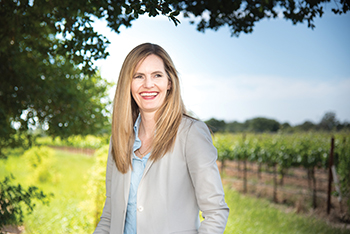 Marissa joined the business in the spring of 2005 to help the family start the winery. She earned an undergraduate degree in neuroscience from Brown University and says she originally had no interest in joining the family business.
“I was a tried-and-true girl from a small town and knew two things,” she recalls. “One, I was definitely not going to work in the wine industry and, two, I was definitely not going to move back to Lodi.”
But while she was studying, Marissa discovered that the industry offered a career opportunity she’d enjoy. During the summers, she worked in the lab of a noted sensory scientist at the University of California, Davis.
“The wine industry is a wonderful, small, but global segment of business that is rich in personal relationships, and I love that very much,” Marissa says. She got her feet wet working in the marketing department of large, global wineries, including Treasury Wine Estates in Napa, Calif. Her experience in the corporate wine world served the family well as it planned to open its own winery.
“We began with my father and I being shoulder to shoulder in every decision. It moved naturally to me making those decisions independently,” Marissa says. “It wasn’t a bright white line for us, but I recognize and know that for quite some time, decision making has rested on my shoulders, and under that I have the support of the family.”
The addition of the winery proved to be a success. “The business was able to really grow, and it really grew a lot over the years,” Randall says. The winery’s “crush capacity” has grown 188% in 10 years.
LangeTwins Family Winery and Vineyards’ first vintage was a 2006 Sauvignon Blanc. The family now has three additional labels: Caricature, Sand Point and Ivory & Burt. Their wines are distributed in California, Texas, Utah, Colorado and the Midwest.
The family understood that wine was a difficult business to break into, Brad says. In addition to producing wine from their own grapes, they make money by providing services to other winemakers. Their bottling facility filled 1.5 million cases last year.
LangeTwins’ winery produced 6 million gallons of wine in 2016. About 75,000 cases’ worth (approximately 178,000 gallons) were bottled under a LangeTwins label.
Cultivating a new vintage
Randall says he hasn’t had any problem ceding control. “I’m living the life, because I see my kids every single day and I see my grandchildren, and it can’t get any better than that,” Randall says. “I really look at my job in this family business and my primary job is to get out of the way. The fifth generation of Langes need to make the decisions. It’s not for me or Brad or Susan or Char. It’s for their children and their grandchildren.”
Marissa says she will never stop feeling like “the daughter” and “the niece,” but that’s something she embraces.
“Without family, it’s just a business,” she says. “I look at my father, mother, aunt and uncle as mentors.”
Randall has embraced his role as an adviser. “I can be a touchstone,” he says. “Marissa will walk into my office and say, ‘Dad what do you think about this?’ I give her my opinion—sometimes she uses it, abbreviates it or ignores it.”
Working with Marissa on the winery side are her brother, Joseph Lange, 34, who handles international sales, and her cousin, Kendra Altnow, 35, who worked with her at Treasury Wine Estates and now has marketing duties at LangeTwins.
 Brad’s son Philip Lange, 37, and Randall’s son Aaron Lange, 37, work in viticulture operations.
Brad and Randall’s relationship is so close that they are neighbors as well as business partners. Their kids grew up together, more like siblings than cousins. This built a bond, Marissa says, adding there is no rivalry in the clan.
The family realized that the fifth generation would need governance structures to ensure family harmony and set the stage for business continuity.
They established a 12-member advisory board; three of the advisory board members are outsiders. There is also a family council, which meets to “address, nurture and develop our relationships,” Marissa says.
The Langes have created a family charter, which Marissa describes as “rules of the road and values that guide decision making and interacting.”
Many of the Langes’ policies were established to prevent them from suffering the fate of other wine families who failed to plan, Marissa says.
“One of two major things that has to be addressed is entitlement,” Randall says. “There is none. You’re paid the wage that you can be paid for the work you do.”
Randall, Charlene, Brad and Susan own 2% of the land. Everything else—the land, the vines and “all that stainless steel, the business and the brand,” as Brad puts it—is owned by the fifth generation.
Brad says it’s important for the next generation to have “skin in the game.” Having ownership gives them the ultimate motivation to succeed, he says.
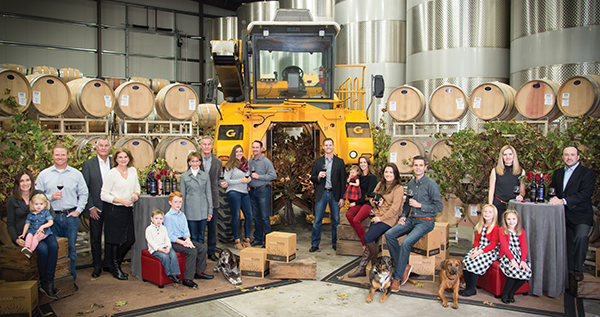
The family charter includes a compensation policy. Family members are compensated according to their level of participation in LangeTwins. At this point, all of the fifth-generation members are involved in the business. There are seven sixth-generation family members, ranging in age from 1 to 10. An eighth G6 is on the way.
The fruits of their labor
Randall has stepped back from running day-to-day operations. In their role as brand ambassadors, he and Charlene host a number of events at the winery, often inviting up-and-coming chefs to prepare the meals. They also travel the country presenting wine dinners, where they share their family story along with their family wines.
Randall says he and Charlene love the off-site wine dinners. “I consider it my best contribution,” he says. “The people in those states aren’t used to seeing the principals of a winery. They are thrilled to see me, which always surprises me.”
“My dad likes to say I promoted him to sales,” Marissa says with a laugh. Her mother worked for the town of Lodi, running the community center and overseeing the construction of a new one before retiring. “When she retired out of that role, I scooped her up after the winery was created. My mother is a phenomenal brand ambassador.”
Brad says you can’t name a business “LangeTwins” and not make both brothers available, so he, too, travels and hosts wine dinners and talks with distributors. But his schedule is limited at harvest.
“We go where Kendra asks us to go, but payday comes in August, September, October,” Brad says. That’s when he has to be in Lodi.
“I might be right in the middle of Chardonnay harvest, and Merlot is right on its heels,” Brad says. “Sometimes I’ll go if I can be back the next day.”
Brad and Susan go into the office just about every day, but are leaving the decision making to the next generation. They see themselves as advisers.
“You spend 40 years building a business, and then all of a sudden you have to give it up,” Brad says. “You have to realize it’s a very healthy thing for a business.
Aaron, Brad’s son, worked with his father for years before taking a leading role in viticulture operations. “Aaron was my right hand, when he first joined the company,” Brad says. “These last few years, I’ve been Aaron’s right hand.”
When he’s not traveling or hosting wine dinners, Randall spends quiet moments at the vineyard, admiring what he and his family have accomplished.
“I drive from my home to the winery,” he says. “I pull into the gate, turn off my pickup and I look at it in total amazement. I had no idea we’d be where we are today. I look back to my dad, and our winery is larger than the winery where he delivered the grapes, and that was a co-op of 40 families. He would’ve thought we’ve lost our minds for taking this risk.”
Copyright 2017 by Family Business Magazine. This article may not be posted online or reproduced in any form, including photocopy, without permission from the publisher. For reprint information, contact bwenger@familybusinessmagazine.com.