








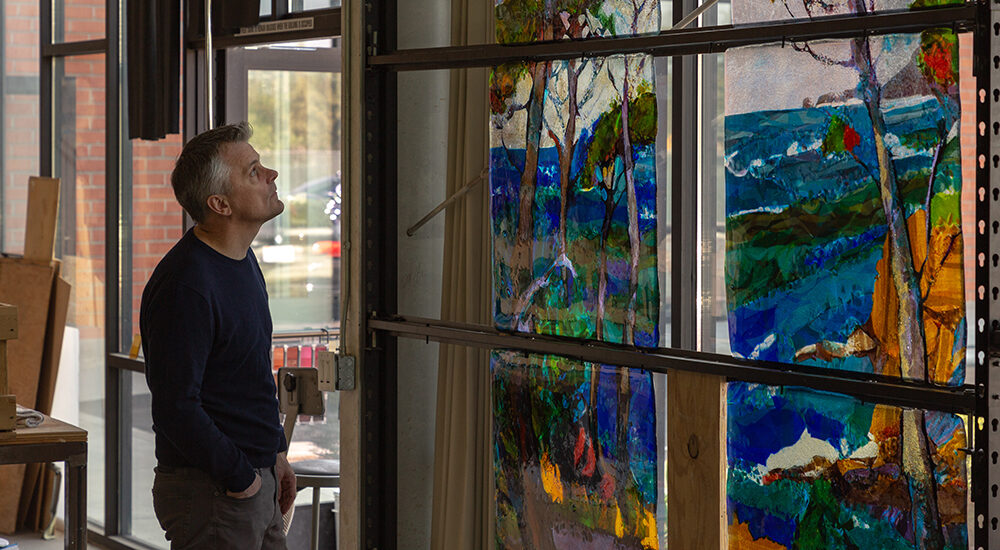
What do you do when the core processes of your family business, largely unchanged for 1,000 years, need a refresh to stay relevant — and profitable — in the 21st century? This was the challenge facing David Judson, fifth-generation president of Los Angeles’ storied Judson Studios, as he took the reins of his eponymous firm 30 years ago.
Almost nothing happens by chance in a stained-glass studio, but once in a blue moon lightning strikes in the form of a client inquiry. Such was the case in 2016, when an architect working on Kansas City’s Church of the Resurrection asked if Judson could create a wall of glass measuring 100 feet wide by 40 feet tall. As it turns out, Judson could and did, and today the church boasts one of the largest stained-glass windows in the world.
“We had never dealt with anything of this scale, and we could barely visualize anything this large,” David recalls. Opportunity was hard on the heels of challenge: “Coming in as the fifth generation, I had to find my own identity to really think about how to continue forward with innovation without being too attached or locked down by what had come before me.”
In the stained-glass trade, different colored panes could not be mixed or fused together effectively until the 1990s. Overcoming that limitation was the eureka moment for David and Judson Studios.
A key player in the development of fused and kiln-formed glass at Judson Studios is its director of innovation, artist Narcissus Quagliata. In kiln forming, heat is used to meld layers of glass, resulting in brilliant effects of light and color not previously possible in traditional stained glass.
One point of pride for David: “Our glass comes from the Bullseye Glass Company factory in Portland, Ore., and all steps of production take place in our Los Angeles-area facilities. Our kiln-formed and fused glass projects are made entirely in the United States.”
A bit of family history
For a case study in achieving the American Dream, take a look at William Lees Judson, David’s great-great-grandfather, the founder of what is today the oldest family-run stained glass studio in America.
In the early 1850s the Judson clan decamped in stages for Brooklyn from Ashton-under-Lyne, near Manchester, England. William Lees, then 12 years old, arrived in 1854, but soon migrated north to Thamesville, Ontario, Canada, on the promise of free land for new settlers. Not content with life as a farmer, he headed back south, ending up in Xenia, Ill., just in time to enlist and serve with distinction during the Civil War in G Company of the 21st Illinois Infantry, then under the command of one Col. Ulysses S. Grant.
When the shooting stopped, William Lees returned to Thamesville, got married and began a family. Meanwhile, his passion for art, clear from an early age, continued to mature. Visits to the salons of London, Paris and Switzerland solidified a vision of his life’s work, catalyzed by time spent at Chicago’s 1893 Columbian Exposition in the massive stained-glass display gallery of Louis Comfort Tiffany. Shortly thereafter, widowed with seven children, William Lees headed for Los Angeles after advice from his doctors to seek a more suitable climate.
By 1895, he had made a name for himself in the emerging L.A. art scene and was earning a living as dean of the new school of art at the University of Southern California. Sons Walter, Paul and Lionel reunited with their father and in 1897 Walter took the lead, opening Colonial Art Glass, destined to become Judson Studios in 1921.
During the Great Depression and World War II, demand for custom stained glass stalled, commissions were shelved and the firm at one point was down to just three employees. David’s grandfather, Horace T. Judson, took a sabbatical to work on aircraft design at Lockheed Martin, returning to the family business in the early 1950s.
Back to the future
“A lot of my work has been to push to see what we can do that is new,” David says. “You have a blessing and a curse, in the sense that we have this strong legacy and tradition that we are striving to maintain while also trying to do different things.”
A major job in 2012 for Our Savior Parish at USC’s Caruso Catholic Center featuring arched windows 25 feet high and 13 feet across pushed the company fully into the computer-aided design world. “We had to make these windows very quickly, and we used photography and composite images which we blended on the computer to design these windows,” David explains.
With nearly 130 years of glassmaking as a legacy, restoration work of past Judson masterpieces also is a big part of the family business. Glass installed in the Air Force Academy Cadet Chapel in the early 1960s, for example, is being restored. Today new commissions of traditional leaded stained glass and restoration of older pieces make up about two-thirds of the company’s book of business, evenly split, and the remaining third is fusing work. It’s more than enough to keep nearly 30 full-time artisans busy.
“My son has started working with us, my daughter is still in school but interested in the family business and we hope to get this sixth generation going strong,” David says. “We’ve nailed down traditional stained glass. That’s our bread and butter, and I don’t think that will go away. The future is wide open for innovation and experimentation, and the advances younger Judsons will bring to the company.”