









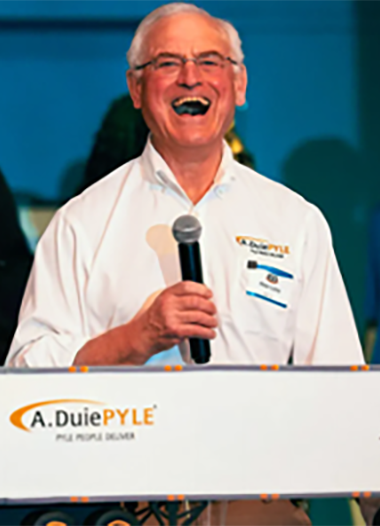
Peter Latta, Chairman and CEO, A. Duie Pyle, West Chester, Pa.
Generation of family ownership: Third.
Revenue: $825 million.
Number of employees: 4,300. We like to say, “our Pyle team” or “our Pyle people.”
First job at this company: I helped in the truck shop half-days in the summer when I was 12. In reality, I mostly got in everyone’s way. After practicing law and working as a CPA for a few years, I started full-time at the company in 1985. By 1989, I was largely managing the business.
Most memorable thing I learned from my father: What determination and commitment mean in practice, and the value of trust. We’re a transportation and logistics provider. In 1979, there was a violent, 14-week Teamsters Union strike at our company. The strike collapsed when about 25 strikers decided to place their trust in my father, resign from the union and cross the picket line. They voted the Teamsters Union out.
Our greatest successes: First, surviving the dislocation of the motor carrier industry that started with the Motor Carrier Act of 1980, which deregulated the trucking industry. That deregulation had a staggering impact over the next three decades. Only three of the top 60 companies are still in business. Second, withstanding a ransomware attack in 2019. For a business that is very dependent on technology and the digestion of information to move thousands of shipments a day, to have to resort to pencil and paper can be pretty crippling. It was a challenge, but we did not pay the ransom and our customers continued to support us. Third, automating one of our warehouses, which enables faster movement of goods and high-performance supply chain solutions.
On my wall: A large tarpon my dad caught when we were fishing together in the Florida Keys. We each had a tarpon on each of our lines at the same time, but a hammerhead shark got mine. It brings back special memories of our time together every time I look at it.
One of my greatest accomplishments: Earning the trust and engagement of the Pyle people, which is our greatest single competitive advantage.
Best advice I ever got: I got the same advice independently from two CEOs of publicly traded companies: “Don’t ever go public.”
Advice for other family business leaders: Maintain a strong focus on both the business of the business and the business of the family, as both directly impact the sustainability and success of the family business. Be willing to make the hard decisions to protect the business from the family.
On a day off I: can be found on my farm taking care of my way-too-large vegetable garden and fruit tree orchard, or tending to my Hereford beef cattle and Berkshire pigs. I also enjoy annual trips to North Dakota with my son to chase wild pheasants with our German Shorthair Pointers.
Books I think every family business leader should read: Doris Goodwin’s “Team of Rivals,” about President Lincoln and his cabinet during what is arguably the most challenging, divisive and turbulent time in our country’s history.
I realized I had emerged from my dad’s shadow… in 1995, in one of our last conversations when he was near death from cancer. I said I hoped I would be as graceful as he was in transitioning leadership of the family business when my time came. His response — that this was one of the hardest things he ever did — caught me by complete surprise because he had made it look so easy. Some years earlier, when I had sought his counsel on some business matters, he appeared to be disinterested and almost dismissive. After our deathbed conversation, I knew then that was his way of telling me it was my time, and no longer his.
Philanthropic causes our family supports: Volunteer fire companies and hospitals, both of which are there for people in a time of need. Also, we have a foundation that provides educational scholarships for the children of our Pyle people.
Words I live by: “The Golden Rule”: Treat others as you wish to be treated.