









The Transformational Women in Family Business 2024 are 16 accomplished women who are propelling their family enterprises into the future.
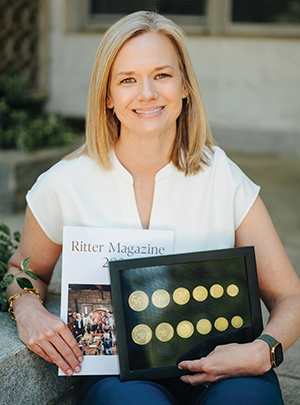
KATY WILDER SCHAAF
Director & Vice Chair | E. Ritter & Company | Marked Tree, Ark.
Katy Wilder Schaaf’s experience proves that family governance can be a powerful way to connect family members to their business — and to each other. Schaaf, a fifth-generation member of the Ritter family, did not grow up near the Marked Tree, Ark., headquarters of E. Ritter & Company. The business began as a general store and transitioned into diverse ventures, eventually becoming the parent company of Ritter Communications and Ritter Agribusiness. Today, the company invests in a portfolio of businesses in agriculture, telecommunications, fire and life safety, and information technology services.
Schaaf studied at UNC Chapel Hill, the University of Maryland and Virginia Commonwealth University and became a psychologist. She and her husband raise their children in Virginia.
“We have a geographically dispersed family,” she says. “Being part of a family business wasn’t a huge part of my identity, and it was only in my early adulthood that I started reconnecting with it.” At the first family business event she attended, the cousins needed to wear nametags.
She joined the family council, “partly just to see my brother more often.” She fit family council work around her full-time job as a clinical psychologist at McGuire Veterans Affairs Medical Center and parenting responsibilities. “At my second family council meeting, I announced that I was pregnant with our second child,” she recalls.
She went on to become chair of the family council and director of development and engagement for the Ritter family. After serving for several years as a board observer, she was named to Ritter’s board of directors and then was elected vice chair of the board.
“The family council really honed my ability to represent the diverse family perspective — to characterize family opinions that are different than my own,” Schaaf says. “The board wants to understand where family members align and where we’re not aligned.”
Balancing family governance with parenthood and a career has been tricky, she acknowledges. “Family business forces us into roles and allows us to flourish. But it can also be really hard. It was a lot of hats to wear. But I feel like I have figured out how to give some of the hats away.”
In fact, Schaaf says, “Being a part of family governance gave me the support and strength to navigate my own path in my career.”
With the family governance role added to her portfolio, she felt she could seize the opportunity to leave her hospital job and open a private psychology practice. “It gave me the courage to be a bit more experimental and flexible in how I went about my work.”
The family and the business have also undergone changes. The Ritter family has added an ownership committee, a forum where shareholders can discuss their vision for the company.
“This idea that family members can participate in a business that they do not directly work in was kind of radical for our family,” Schaaf says. “I don’t think we felt entitled to have many opinions around the business — and that, in some ways, probably was really difficult for the business, because owners need to have a certain vision and structure that they share with management and the board.”
E. Ritter & Co. sold a majority stake in Ritter Communications in 2019. It developed a portfolio board and a new vision for the company centered on a diversification strategy. This year, fifth-generation member Erik Kesting became the company’s CEO.
“Family governance has helped me learn more about the business,” Schaaf says. “Family governance has helped me to learn more about being a family leader and take on leadership roles. Family governance has taught me about how to navigate disparate opinions about how to move forward. Family governance has allowed me also just to enjoy my family, I think, in a way that I wouldn’t be allowed to if we weren’t all in business together.”